Watering a foundation reduces the need for Corpus Christi foundation repair by keeping soil moisture steady rather than swinging. A system costs $500–$2,500 against $4,000–$15,000 for underpinning. The aim is even, not wet.
Why it works here specifically, how to run it through a year, and the four ways people get it wrong.
Why it works on this ground and not everywhere
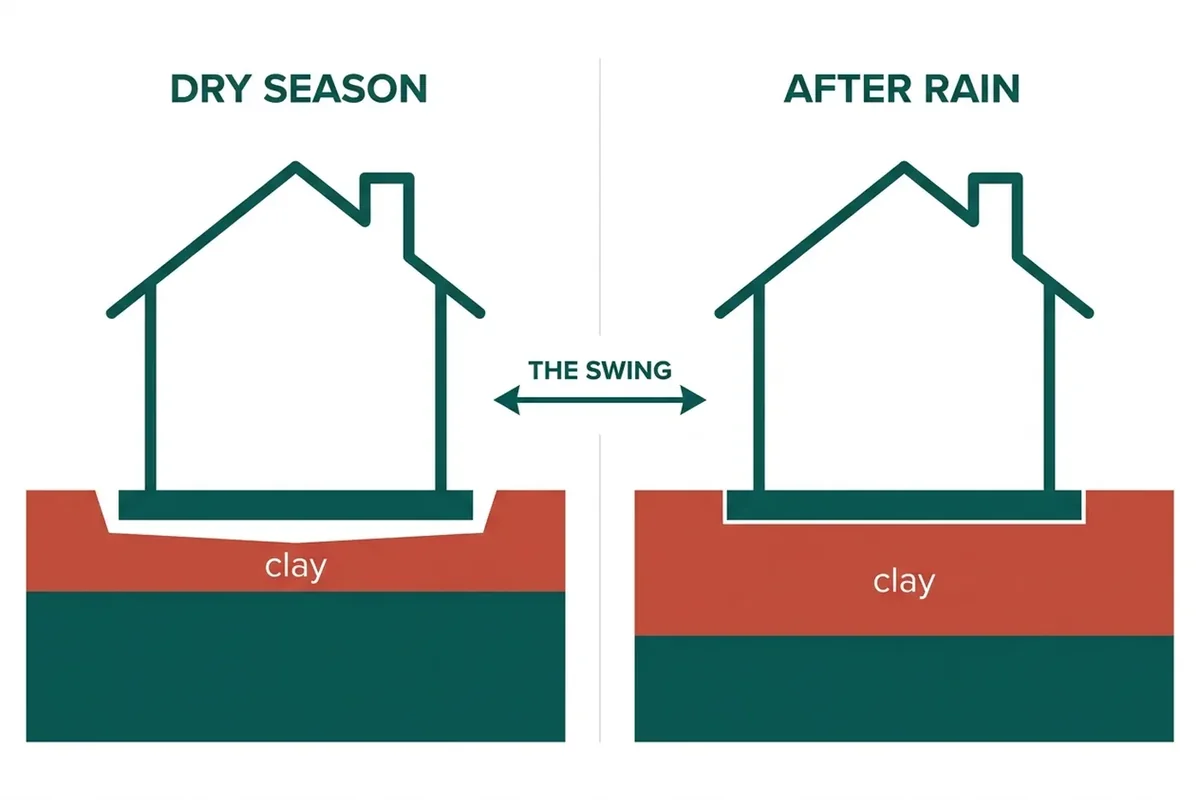
Clay damages foundations by changing volume. Nueces County clay has a linear extensibility up to 18.7 percent, meaning it can change dimension substantially between wet and dry — and this market only receives 31.76 inches of rain a year with 3,523 cooling degree days working against it.
So the soil here spends long stretches well below its wet-state volume and then gets recharged in lumps. September brings 4.98 inches; January brings 1.54. Somewhere in between, your house is being lifted and dropped.
Adding a small, steady amount of water through the deficit narrows that range. It does not make the soil behave like sand; it stops the soil visiting both ends of its own range twice a year.
Running it through a year
| Period | What matters |
|---|---|
| Late autumn and winter | Do not switch it off. The dry months here include November, December and January, and a system that only runs in summer creates the swing it was meant to prevent |
| Spring | Watch what the rain is doing and reduce rather than stop. March and April average under two inches |
| Peak summer | The heaviest demand, and the period when a tree on one elevation will beat any hose |
| September | Usually the wettest month. Back off, because adding to a 5-inch month is how people saturate one side of a house |
A timer does this far better than good intentions do. A common failure is a regime that runs faithfully in August and is forgotten by November.
Four ways it goes wrong
- Too close to the slab. Water running down the foundation edge wets a narrow strip and softens bearing soil instead of conditioning the soil mass
- Too much. Saturated ground is a different problem, not a safer version of the same one, and it can drive water toward plumbing you cannot see
- Uneven. One side watered and another neglected produces exactly the differential condition the whole exercise exists to prevent
- Seasonal. Summer-only watering builds a bigger annual swing than doing nothing at all in some cases
What this cannot do, and when foundation repair takes over
It cannot recover elevation. A house that has already dropped an inch at one corner stays there; what changes is whether it keeps going. If you want the elevation back, that is underpinning, and a good specialist will tell you which situation you are in before you buy either.
It also cannot outrun a local cause. A mature tree pulling on one elevation, or a leak under the slab, will defeat an even regime because they are concentrated and it is not. Those should be identified first; details on the stabilisation page.
Watering, answered plainly
Does watering a foundation actually work?
On clay in a rainfall deficit it can, because the damage comes from moisture changing rather than from soil being dry. Holding a steady moisture content year-round reduces the swing that moves houses. It will not lift a house that has already dropped.
How much water, and how often?
Little and often beats a lot occasionally, and consistency across the whole year matters more than volume in any one week. The soil should stay evenly damp rather than wet, and the regime should not stop in December just because the weather cooled.
Where should the line go?
Set back from the slab rather than tight against it, so water soaks into the soil mass rather than running down the edge of the foundation. The exact distance depends on your grading and soil, which is one of the things to ask about during the assessment.
Can I overdo it?
Easily, and it causes real problems. Saturated soil against a foundation softens bearing material, can push water toward under-slab plumbing you cannot inspect, and creates its own uneven pattern if one side gets more than another.
What about water restrictions?
They apply and they should be observed. Municipal restrictions vary and change with drought stage, so check current rules with your water provider. A drip or soaker regime uses far less than sprinklers, which sometimes matters to how restrictions apply.
Is this instead of repair or as well as it?
Both, depending on the house. On early or purely seasonal movement it can be the whole answer. After underpinning it remains relevant, because pilings support the beam while the clay under the interior slab carries on swinging.
Book a Corpus Christi foundation assessment
Two things help most before the specialist gets there: roughly what year the house went up, and whether the trouble showed up during a dry spell or after heavy rain. On this ground the season it appeared in narrows the cause faster than the size of any crack does. You get a call back from a local specialist who serves Corpus Christi.